
Words from a master


A few days ago I stumbled on an interesting article about a Portuguese writer by following a random link as I browsed through articles I’d missed in BBC newsletters.
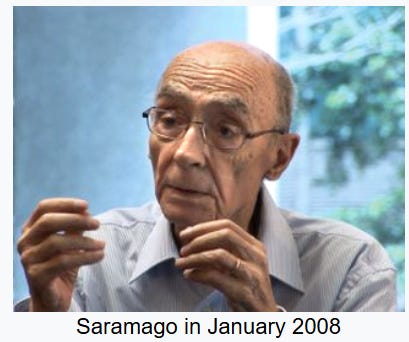
Recipient of the 1988 Nobel Prize in Literature and polarizing socialist, José de Sousa Saramago (16 November 1922 – 18 June 2010) wrote parables of imagination, irony, and compassion.
When asked to describe his daily writing routine in 2009, Saramago responded, “I write two pages. And then I read and read and read.” Source: The Guardian 2010.

Before I started writing creatively, I consumed books, at least one a week, even when I was working. Now it’s the opposite. I work on my own writing, but I rarely have time to finish the books I enthusiastically purchase—ten started, none completed.
I suppose there is a time for writing and a season for reading, but I’d love to find some place in the middle where I can carve out daily quiet time to read. But it’s become difficult with all the noise around me.
Chitter chatter, TV blaring, and the daily lives of those around me do not affect my writing. I can pen words while almost anything is happening. (I honed this skill as a reporter and then as a tech writer.) Telephone conversations and loud distractions were always blaring from every direction.
Despite that ability, I cannot immerse myself in other worlds when the one I live it is full of everyday racket.

Still, I think Saramago’s words are important during a time of mass production, even in writing. I suppose many people think that the more words flung out there, the better chance of success—meaning making more money.
If AI slop (and even AI-produced decent work) is inundating not only social media and every corner of the Internet, is built into software products, even MS Word, appears in printed books, and magazines, then many of us will find it difficult, if not impossible, to find a solid base of readership.
The proliferation of AI, even here on this platform, lures many to succumb and use it. Just to keep up with the times.
It is not for me, and I’d like to attempt an explanation. (I am not a luddite. I spent my entire money-making career writing tech pubs in Silicon Valley, CA.)
Not being able to write exactly two pages a day, I don’t take the master’s advice literally. Sometimes, I write two sentences. Sometimes 1,000 words. There are days where I cannot write anything at all. I just think, remember, and dream.
I ground myself in one thought: quality, not quantity. I must admit, my quality never seems to measure up in my mind to the books I choose to read. But great books do remind me what quality really is. I try to learn from them.
The first book I must finish? The Sea by John Banville. If you are not familiar with it, read the first page, and you will understand what I am about to write.
Perhaps you have read outside your comfort zone, as I try to do. You know … that thing that happens when you pick up a book like The Sea and think: oh hell, I’ll never be able to write like that.
I usually think: I am not productive enough to succeed. I can’t write enough fast enough. And it’s not even any good. Nevertheless, I continue my solitary work despite my doubts, because I cannot stop writing.
Please, do not succumb to using AI to write and publish. How will you master the craft if you let a “machine” that is built on thieving successful writers’ words tell you how to write? To give you drafts to fiddle with until they appear to be your work. To do your editing for you?
I might never publish a book, let alone have it acknowledged. But I write all my own words, and I edit them many times over before I release them. I’ll never use AI to up my production or “fix” my work. For me, such a step would dishonor the dead masters, including my grandmother, who wrote all her words a century ago.
Perhaps when we persevere as individuals, with all our faults, weaknesses, and lack of skill as we write—without the help of AI—we become living, breathing, passionate writers following in the footsteps of the dead masters.
Who knows? Maybe someday, somewhere, somebody might say about something we publish: “Oh, I could never write like that!”

Feels like a gentle writer gremlin tapping the desk and saying, “Slow down. Read more. Make fewer, better words.”
Loved the loyalty to craft here—writing even when it’s messy, doubting everything, honoring the old masters, and still showing up with your own hands on the page. Quiet, stubborn, and kind of brave.
I like it. I tend to write constantly, and find little time for reading so I may take this and tweak it.
Writing in the morning when my mind is busy, reading in the afternoon, and then if I want something else, reading, writing, editing or entertainment after dinner.
It’s a good compromise to at least carve out time for reading.